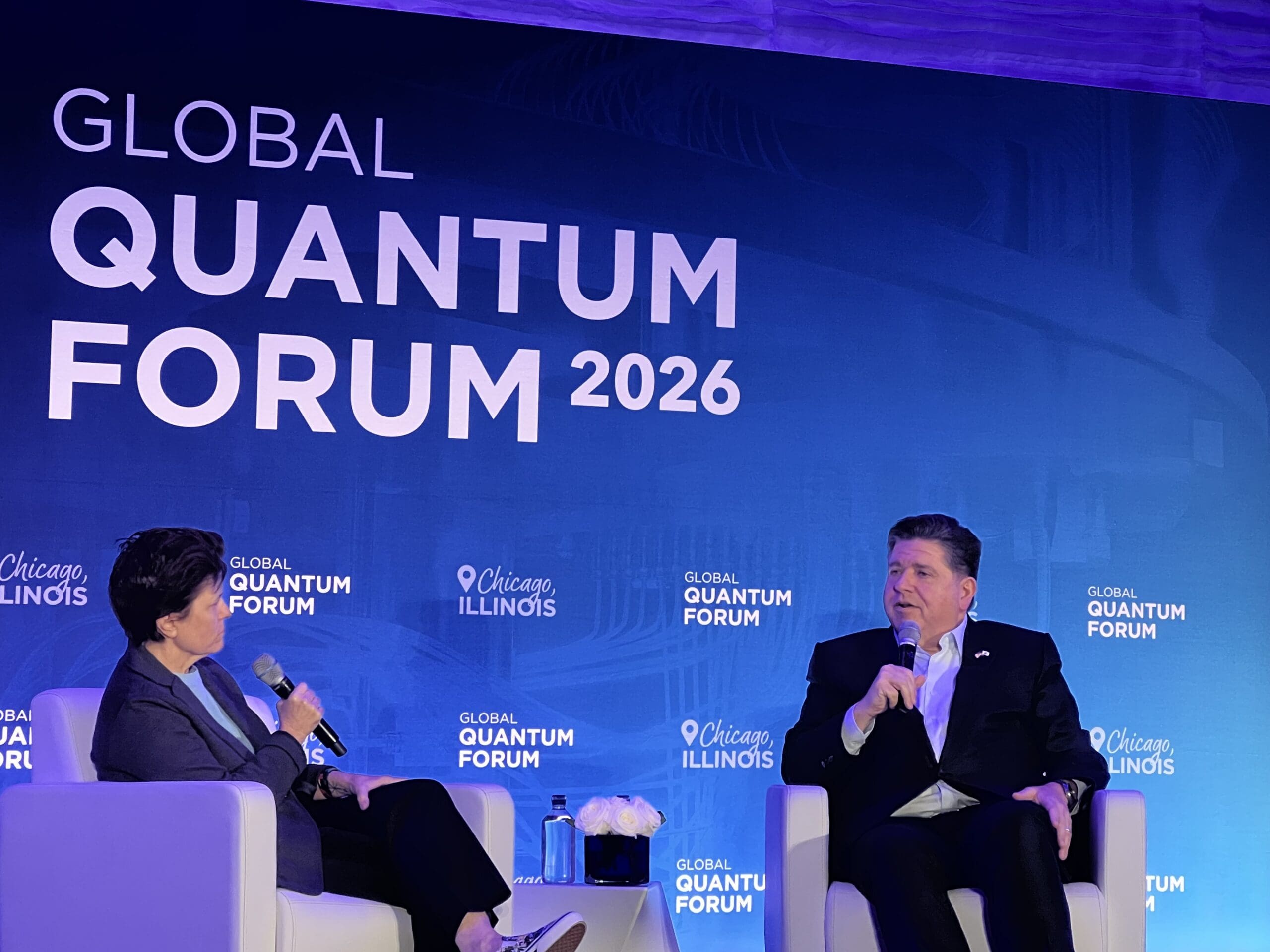
Kara Swisher interviews Illinois Gov. J.B. Pritzker at 2026 Global Quantum Forum in Chicago.
Published on August 31, 2026
The Global Quantum Forum brought hundreds of quantum leaders and investors to Chicago on July 22-23, 2026, signaling the Midwest’s emergence as a critical hub for quantum technology commercialization. Geographic advantage in infrastructure, talent, and policy now determines which regions capture economic value.
The quantum industry remains capital-intensive and talent-constrained. Most venture funding and workforce development concentrates on coastal tech hubs. Yet the Midwest, particularly Illinois, is building deliberate advantages: the Chicago Quantum Exchange, a university-led consortium; the Illinois Quantum Materials Program (IQMP), which funds applied research; and state-level policy coordination through the Year of Illinois Quantum initiative.
The forum’s Chicago location reflects where quantum economic activity is actually concentrated in the Midwest and what barriers Midwest companies face in scaling quantum applications.
The forum’s attendee mix and agenda reveal a market shifting from theoretical possibility to near-term commercial application. Pharma, financial services, and advanced materials represent the initial wave of quantum adoption. Midwest manufacturers in these sectors now have direct channels to quantum expertise through Chicago-based institutions and state funding programs. The constraint is not access to technology or capital, but workforce capability and internal organizational readiness.
| Finding | Data Point | Implication |
| Quantum opportunity concentrated in pharma, materials, and finance | Forum attendees included pharmaceutical leaders, advanced materials researchers, and financial institutions seeking quantum advantage | Midwest manufacturers and life sciences companies have direct access to quantum expertise without relocating |
| Illinois funding ecosystem expanded in 2026 | Illinois Quantum Materials Program allocates research grants; Year of Illinois Quantum coordinates cross-sector partnerships | Regional companies can access quantum R&D support through state programs without competing solely on VC capital |
| Talent pipeline remains the bottleneck globally | Forum agenda emphasized workforce development as critical to adoption | Midwest universities (University of Illinois, Northwestern, Argonne) have begun filling the skills gap, but demand outpaces supply |
| Policy alignment emerging as competitive advantage | Forum included policy sessions and government representatives | States with clear quantum incentives attract both research investment and commercial applications faster |
| Commercial timelines accelerating | Early-stage quantum solutions now target 2026-2027 deployment in specific use cases | Midwest companies have 18-24 months to position themselves before quantum advantage becomes commonplace |
Quantum computing is no longer a general-purpose technology waiting for breakthroughs. Instead, specific use cases in drug discovery, optimization, and cryptography are moving toward commercial deployment in 2026 and 2027. Pharmaceutical companies, which make up a significant portion of Fortune 500 headquarters in the Midwest, can now run pilot programs to accelerate drug candidate screening. Materials science companies can use quantum simulation to design new compounds with less trial-and-error. Financial institutions can begin optimizing portfolio allocation and detecting fraud patterns using quantum algorithms.
The forum’s emphasis on “exploring the future of quantum across policy, investment, business” signals that investment decisions are now being made. This is not a five-year horizon anymore. Companies attending the forum are evaluating deployment readiness for 2026 and 2027. Midwest organizations that attended or are represented by peers have concrete timelines and partnership options. Those that did not yet assess their quantum readiness are falling behind not in research, but in business planning.
The implication for Midwest manufacturers: quantum advantage is no longer about being first. It’s about being early enough to integrate quantum solutions into your competitive position before your competitors do. For a Midwest pharma company, that means engaging with Chicago Quantum Exchange partners now to pilot quantum-accelerated screening. For a materials company, it means assessing which simulation problems would benefit most from quantum speedup and planning pilots for late 2026 or early 2027.
The Year of Illinois Quantum initiative is coordinating across universities, the IQMP, and industry to build the talent pipeline and institutional infrastructure that allows companies to move from pilot to scale. The Illinois Quantum Materials Program specifically aims to develop life-saving medicines faster. These programs exist because Illinois saw that capital and technology were moving to the Midwest, but the Midwest was losing competition for talent to coastal hubs.
Quantum advantage is moving from research to application faster than most Midwest businesses expect. The forum was not speculative; it centered on commercial deployment, policy, and investment decisions. Midwest companies outside pharma, finance, and advanced materials should be asking whether quantum solutions apply to their optimization, simulation, or security problems. If the answer is yes, your timeline is 18-24 months, not five years.
The quantum revolution offers several highly actionable opportunities for Midwest economic development:
The forum’s location in Chicago, home to Argonne National Laboratory and the University of Illinois system, is a deliberate statement: the Midwest’s quantum advantage is not venture funding or startup culture. It’s deep research infrastructure, university partnerships, and proximity to manufacturing. A biotech company in the Milwaukee area or a materials firm in the Chicago suburbs can now access quantum expertise from Argonne or the University of Illinois without relocating employees. This is a competitive advantage the Bay Area cannot match, because proximity to a national lab and a top-tier university system is geographic, not transferable.
Geography matters in quantum commercialization because quantum requires deep institutional partnerships. Unlike cloud software, quantum advantage requires access to expertise, hardware, and long-term R&D collaboration. The Midwest’s advantage is not cost or venture funding; it is the concentration of research institutions and manufacturing hubs in a single region. Illinois, Indiana, Ohio, and Wisconsin now have the infrastructure to support quantum-enabled manufacturing and life sciences at scale. Companies in these states have a structural advantage in cost of access to expertise and partnership.
Capital (venture, government, corporate R&D) is abundant for quantum, but the number of people who can design, deploy, and operate quantum systems is still small. While quantum computing is often associated with PhD researchers, industry leaders at the forum emphasized that scaling the technology will require a massive trades-based workforce.
The build-out will rely on local labor to construct facilities, manage power and cooling systems, and manufacture components, creating inclusive economic opportunities similar to the original Industrial Revolution. PsiQuantum’s new facility alone is expected to bring 150 to 200 jobs to the South Side.
The Year of Illinois Quantum and the Illinois Quantum Materials Program exist to address this. Companies that partner with these initiatives in 2026 will have access to trained quantum talent earlier than competitors in other regions.
The talent bottleneck is real, but it is narrowing. Companies that engage with these institutions in 2026 will have first-pick access to the next cohort of quantum-trained engineers and researchers. Companies that wait until 2027 will compete for remaining talent. This favors early movers, particularly those with existing relationships to Illinois universities or Argonne.
Industry analysts and research institutions attending the forum stressed that the window for building quantum advantage is narrow. Technologies, partnerships, and talent pools are consolidating around a few hubs. The Midwest is in that consolidation now, in 2026. Companies that move now will shape the quantum landscape in their sectors. Those that wait until quantum becomes mainstream will compete on adoption speed and integration, not on strategic advantage.
The forum’s emphasis on “life-saving medicines” and quantum-accelerated discovery is direct. Engage with the Chicago Quantum Exchange, propose a pilot project, and allocate R&D budget for 2026-2027 quantum screening. Your timeline is months, not years. Argonne and the University of Illinois have the expertise and hardware access. The state has funding mechanisms to offset pilot costs through the Illinois Quantum Materials Program.
Quantum simulation can reduce the iteration cycles on new compounds or alloys. The same institutions offer partnership pathways. The difference from pharma is that you may need longer to see ROI, but your first-mover advantage is also larger. Engage with the IQMP and Chicago Quantum Exchange to scope a pilot for late 2026.
Quantum optimization for portfolio allocation and security is closer to commercial reality than materials or pharma. Pilot timelines are shorter. The forum included finance sector representation. If your institution was not represented, contact the Chicago Council on Global Affairs or Chicago Quantum Exchange to understand the partnership model and whether quantum advantage applies to your operations.
The quantum opportunity is different. Your role is supporting clients’ quantum pilots and integrations. Building expertise in quantum software, integration, and change management is urgent. The talent pipeline will be tight through 2027. Firms that hire quantum-trained engineers and consultants in 2026 will have a two-year lead on competitors.
The forum’s agenda and attendee composition reveal a commercialization timeline, not a research roadmap.
Pharmaceutical and life sciences saw the largest representation, reflecting that quantum drug discovery is closest to deployment. Materials science was the second-largest sector, with quantum simulation moving into pilot phases. Finance attended in force, targeting optimization and security applications. Policy makers and government representatives participated, indicating that quantum policy (export controls, workforce funding, IP protection) is being locked in during 2026.
The forum’s emphasis on “policy, investment, business” across two days signals that these elements are now integrated. Policy is no longer separate from business. Investment decisions are being made now, not in future funding rounds. This matters because it compresses the timeline for adoption decisions and partnership formation. Companies that participated in or monitored the forum have actionable intelligence. Those that did not now need to accelerate their own quantum readiness assessment.
The timeline for quantum commercialization is accelerating, but mid-market companies do not need to build independent quantum divisions to compete. Your strategy for the next 18 to 24 months should focus on building internal readiness and leveraging regional ecosystems to explore pilots without carrying the full R&D risk.
If your organization relies heavily on complex optimization, financial modeling or materials simulation, here is your pragmatic roadmap for 2026 and 2027:
Watch: How utilities are pivoting from traditional infrastructure management to empowering consumers through interactive, tech-enabled grids.
Takeaways:
Watch: The convergence of Artificial Intelligence and Quantum Computing as dual platform shifts, and how they will reorganize corporate hierarchies and workflows.
Takeaways:
Watch: Navigating international alliances, export controls, and the global race for quantum supremacy, particularly in the United States, the United Kingdom and Australia (AUKUS).
Takeaways:
Watch: Placing quantum computing within the historical framework of technological revolutions and understanding neutral atom technology.
Takeaways:
Watch: How the limits of current AI computing power are driving the integration of quantum technologies, and how enterprises can prepare.
Takeaways:
Watch: Federal mandates, post-quantum cryptography (PQC), and the complexities of building a secure global quantum supply chain.
Takeaways:
Watch: Moving quantum from the lab to the market through major infrastructure investments, highlighted by progress at the Illinois Quantum and Microelectronics Park (IQMP).
Takeaways:
Watch: Addressing the massive power and real estate requirements needed to sustain the concurrent growth of AI and quantum computing.
Takeaways:
Watch: Private capital, market readiness, and assessing global competition in quantum technology.
Takeaways:
Commercial quantum computing at a smaller scale is expected to see real-life enterprise applications within the next 5 to 7 years. However, early pilot programs in pharma, advanced materials and finance are already targeting deployment for optimization and simulation in 2026 and 2027.
No. Companies do not need to own quantum hardware to gain a competitive advantage. Enterprises can access quantum processing through cloud-based Quantum-as-a-Service (QaaS) platforms or by partnering with regional hubs and research universities for specific pilot projects.
The Midwest is emerging as a global commercialization hub by combining deep research infrastructure with legacy manufacturing. Initiatives like the Chicago Quantum Exchange and the Illinois Quantum and Microelectronics Park (IQMP) provide the physical supply chain, cooling infrastructure, and talent pipeline necessary to move quantum from the lab to enterprise scale.
The immediate threat is “Harvest Now, Decrypt Later” attacks, where adversaries steal encrypted data today to decrypt it when quantum computers mature. Organizations must immediately begin transitioning their networks to Post-Quantum Cryptography (PQC)—a software-based encryption standard designed to withstand both classical and quantum decryption.
As soon as you submit the form, we will send to you a link to download our report.